
OPEN SPECIFICATION
PAVS — Open Specification for Physical AI Verification & Scoring
PAVS defines how to score physical AI in simulation, how to verify that scoring, and how to report the result.
Status of this specification
- A proposed open specification. It is not a standard of ISO, IEC or KS.
- Published by ImmersiveCast Co., Ltd., which is not a certification or accreditation body.
- Existing international standards (ISO 9283, 10218, 18646, 3691-4 and others) are cited as reference standards; no conformity certification against them is implied.
- The specification text is neutral to products and organisations and carries no trademark. Implementations are named only in separate profiles.
The standards stack — the middle is empty
Standards exist above and below. What is missing is the middle layer: where a value came from in simulation, and whether a verdict was established at all.
Test scope and procedure
ISO/IEC TS 42119-2 (2025) — testing of AI systems
The layer this specification governs
Provenance of measurement · establishment of the verdict · how the result is stated
No standard governing this layer was found within the scope reviewed (public sources, 2026-08)
What is measured
ISO 9283 · ISO 18646 · ISO 3691-4 · ISO 10218
The standards above and below presuppose physical testing; measurement, verdict and reporting in simulation fall outside that premise.
Five requirements for trustworthy scoring
PAVS defines scoring as a chain of five stages and defines the requirements of each axis as 72 test assertions. A test method is specified for all 72 (injection 36 · inspection 33 · demonstration 3). Conformance is determined from the records of tests performed under this procedure.
- 1
Test items
What is measured
- 2
Measurement
Where the value came from
- 3
Verdict
The pass criterion
- 4
Verification
Evidence behind the verdict
- 5
Reporting
How the result is stated
Unmeasured is not a pass
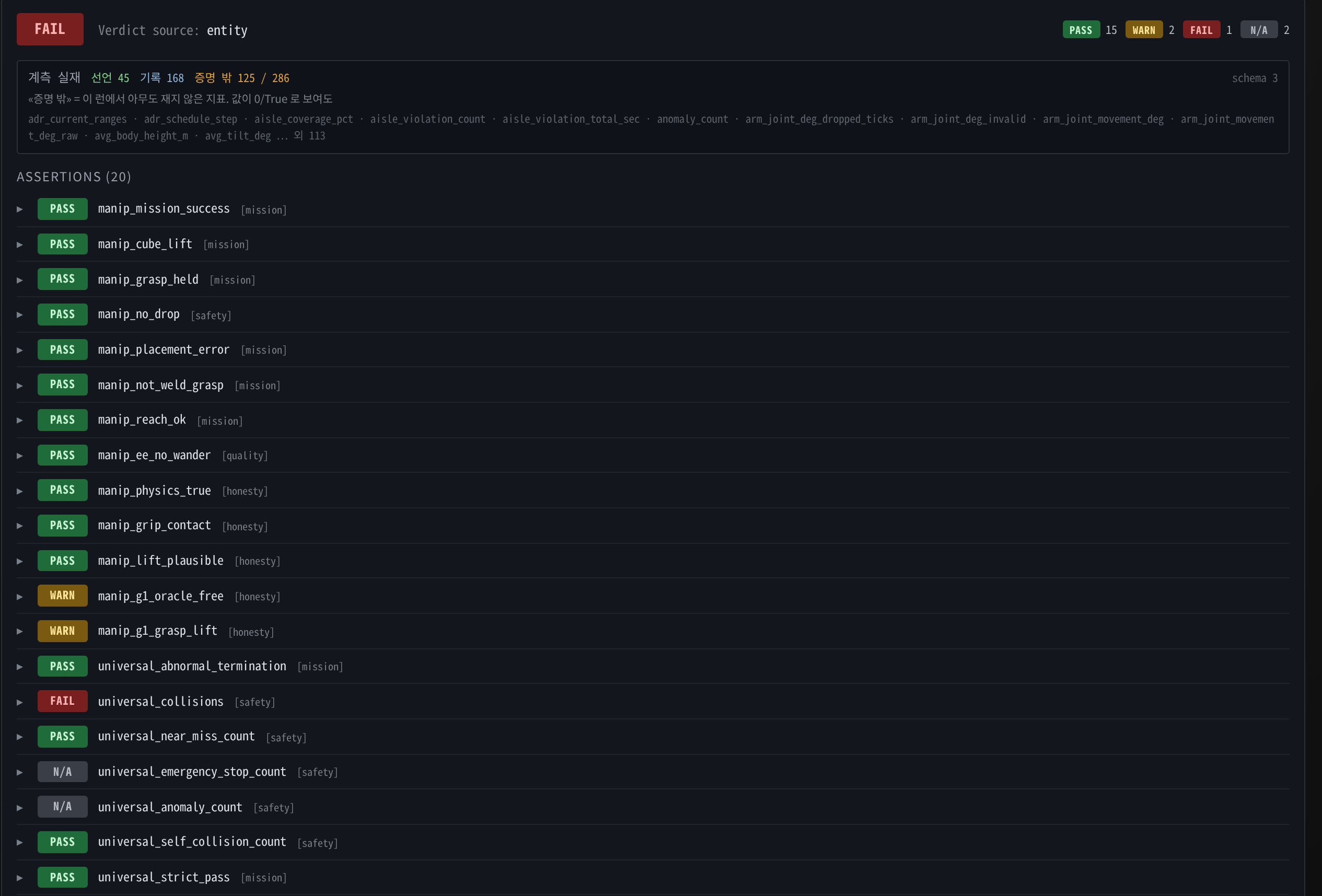
Scoring has three outcomes, not two. If the measurement or stimulus an item requires never took place, the result is neither a pass nor a failure.
Pass
Established — every condition met, by measurement
Fail
Established — measured, and the condition was not met
Not measured
Not established — no stimulus, unit mismatch, or no instrument
Not measured is never counted as a pass. A missing measurement for a mandatory item is treated as a fail with the reason “measurement absent”, and the number of unmeasured items is kept separately. A value that appears as 0 or “true” has not thereby been measured. (PAVS-VDT-01 v1.2)
The authors tested themselves first
On 4 September 2026 we tested the imSim scoring system against v1.2 of this specification. The results are published as they are. The current version, v1.4 (2026-10-19), is an editorial revision with the same assertion requirements.
72
Test assertions (Annex A)
7
Met — self-test, 2026-09-04
3 / 8
Core assertions met
The specification forbids claiming conformance while any core assertion is unmet. The imSim scoring system is therefore described as "PAVS-aligned", not "PAVS-conformant". All 65 unmet assertions are listed individually in the conformance statement. The test was carried out by the developing organisation itself and is not a third-party audit; the conditions that would invalidate it are stated in the statement.
The artefacts
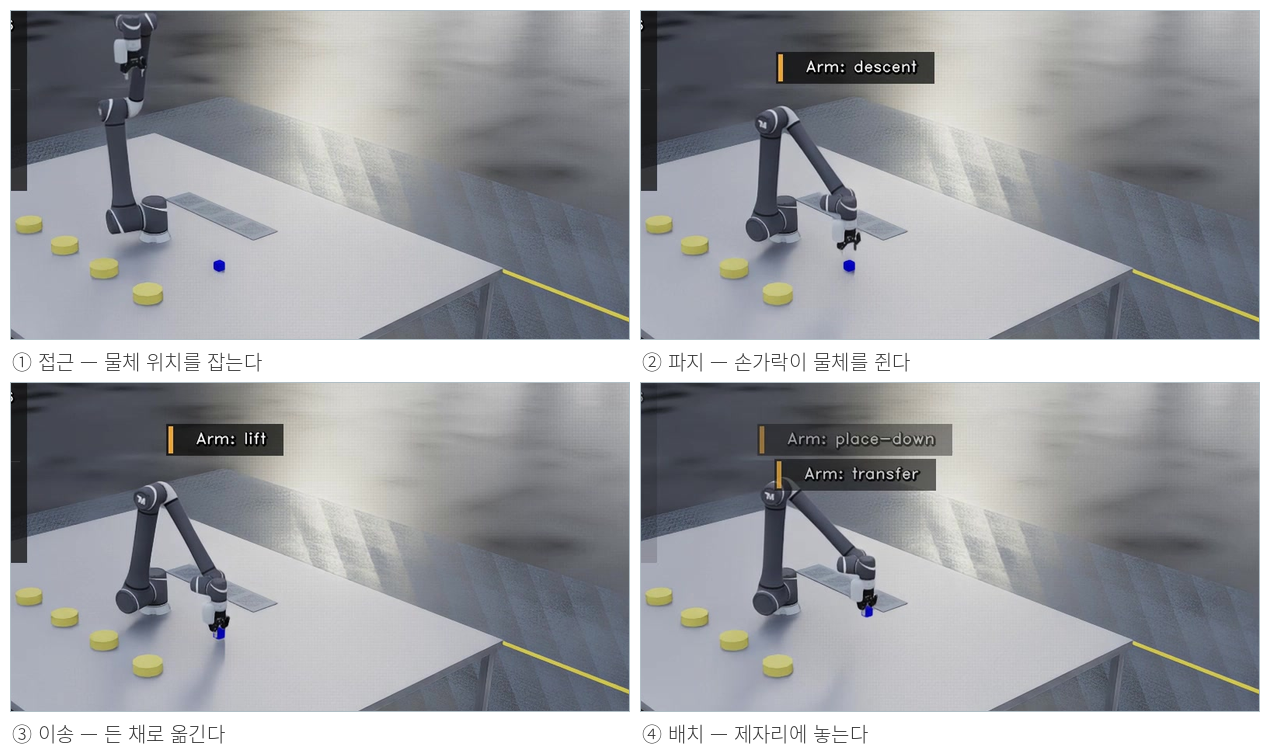
What follows is not illustration. These are real outputs of the system.
Domain profiles
The specification body is domain-neutral. Which items each domain measures and which it excludes are published as a profile. The first profile covers the military domain.
Military profile
PAVS-PROFILE-MIL v0.6 · 2026-10-10 · correction 1 2026-10-13
Published v0.6 — publisher's self-check · no third-party review
25
military measurement items
16
common items
21
explicitly excluded items — reasons published
- The first tests are 8 unmanned-surface-vessel encounters (4 COLREGs types × comply · violate). Compliance passed and violation failed, confirming the scorer's discrimination.
- We injected 9 attempts to weaken the requirements; all 9 were rejected (self-check).
Limits
- 0 perception or sensor measurement items — this version covers coupled tests only.
- Verdict thresholds are our own settings, not yet agreed with a procuring party.
- Some test types do not yet have a negative control.
Documents
The specification documents are currently published in Korean only.
- White Paper (Part 0) v1.2informativeThe background and design rationale of this specification. Covers the precedent of simulation-based validation institutionalised for autonomous driving, the gap in robotics, and the publisher's self-test results.PDF
- Specification (Part 1) v1.4normativeRequirements and conformance. Specifies 72 test assertions and the test method for each. v1.4 = an editorial revision with the same requirements as v1.2.PDF
- Casebook (Part 2) v1.2informative39 incidents from which clauses arose. Actual records of scoring that went silently wrong, with no error shown, are given as the basis for the clauses.PDF
- Conformance Statement v1.2self-declarationResults of testing the imSim scoring system against this specification (test date 2026-09-04). Every met and unmet item is disclosed.PDF
- Reference Implementation (Part 3) v0.5informativeThree demonstrations that execute the specification's test assertions in an actual implementation, and the composition of the run package. An assertion shown to be executable is not thereby judged as met.PDF
- Military profile v0.6Domain profileWhich items are measured and excluded in military scenarios, the verdict mapping, the self-check and limits, with the results of the first tests (8 maritime encounters) as an annex. Based on Part 1 v1.3.PDF
Specification inquiries · joint pilot test
We welcome inquiries about the specification's clauses, its test methods and joint pilot tests. New domain profiles, or conformance statements for other implementations, can be written in the same format.
contact@immersivecast.com